This month’s Hmmterviewee is Dino Ge Zhang, a media anthropologist, non-fiction writer, and Associate Professor in Digital Culture at the University of Bergen. He is the founding editor of the Bureau of Low Theory, a web database of internet culture and underground theory from China. His research follows livestreaming across the Sinophone world, from China’s early streaming cultures to the vulgar aesthetics of Kuaishou (快手), and works towards an ethnographic theory of boredom. On Wednesday 25 November, he leads our guided tour of the Chinese internet on The Inbetween.
Read below to find out more about Dino’s thoughts on the internet.
How many browser tabs do you have open right now (and what for)?
I use three browsers, each for different purposes: Chrome, Firefox, and Brave. Currently, I have 120 tabs open in Brave, 57 in Chrome, and 2 in Firefox.
I reserve Chrome strictly for work stuff, administrative tasks (various forms and spreadsheets), grant application portals, teaching portals (e.g., Canvas), and other government portals that require logins. Brave is my default browser that I use for general browsing of the internet for research and leisure; currently I have a bunch of tabs open for X, Reddit, and BlueSky timelines, Wikipedia entries, Letterboxd entries, are.na collections, Bandcamp artists, some online mag articles, indie press websites, Google Docs, GitHub pages, Substack and blog posts, some pages from the website “Dictionary of Arguments: Philosophy Lexicon”, and a bunch of academic articles. Chinese sites include some Zhihu posts and some Douban lists. Firefox is just used to play YouTube videos.
What’s your favourite place on the internet?
Technically speaking, most of my time spent on the internet would be YouTube (most of it being passive). YouTube is background noise in various ways: podcast or livestream passivity, or ambience of a soothing voice narrating the latest scientific discoveries, or video essays on sports, films, games and music. But I cannot say I like YouTube as a place today; it is too generic to be a place one can ‘dwell’ in today. The same can be said for all the mainstream social media platforms today. I have not had the feeling of a ‘cozy’ dwelling on a website/online community for a long time. There is a certain sense of impasse that while you do still find nice things (say, on Instagram reels) in different places or fleeting moments of enjoyment but not a ‘place’ that I consistently return to, with a sense of ontological security.
What’s the weirdest thing an algorithm has recommended to you lately?
An Instagram account called Norwegian.npc, a series of short animations caricaturing life in Norway. Probably AI-generated, but it was very weird in its sense of humour. I moved to Norway about five months ago. It was not until last week that I started to be consistently fed Norwegian content by the reel algo slot machine; my different interests, weird internet memes/brainrot and bokmål norsk started to intersect in unforeseen ways.
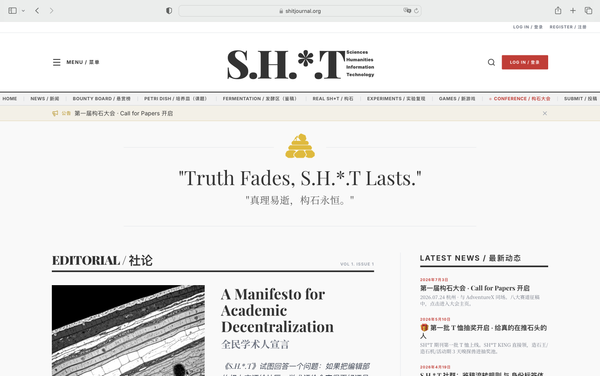
For something Chinese internet, https://shitjournal.org/ This is a site made by disgruntled graduate students in China to make fun of the already ridiculous level of academic ‘garbage’ they are forced to generate because they are often required to publish to graduate. So they made a journal that is called shit journal.
Is there a corner of the internet you miss that no longer exists?
In general, Blogsphere (RSS reader!), IRC, and early Twitter.
(Most established ‘platforms’ today had exciting, sometimes even utopian, periods in their early phase in one way or another)
Some Sinophone sites: the Chinese blogsphere on Xanga (HK/Cantonese) and Blogbus (China/Mandarin). A Dao (literally ‘A Island’; China/Mainland) anonymous discussion board, and early AcFun. Hong Kong Golden Forum (HK/Cantonese). Some of these still exist but have completely lost their former identities.
The websites I missed the most are self-hosted private forums based on specific interests; for me, it was music taste; but none of these left any public records.
What’s something Western users always get wrong about the Sinophone internet?
Sinophone internet is a term that is rarely used. I would like to distinguish it from the Chinese internet.
First, I will talk about the Chinese internet. China built the Great Firewall to insulate its internet from the rest of the world. It is not simply for the purpose of censorship, as this insulation created a parallel world of media ecology and a prosperous platform economy, blocking all international competition. It is not simply a copy of the American platform economy.
Didi copied Uber at the beginning, but it then developed into a different kind of monster, gradually adapting to demands from both users and the party-state, while also trying to milk as much money as possible. Elon Musk’s aspiration for an ‘everything app’ is a banal fact in China, not just for WeChat but for every single app. A platform for livestreaming might also offer loans with a high interest rate, and you can also do shopping, maybe even order food deliveries.
The common perceptions of the Chinese internet, observed from afar, often ended up being either too techno-utopian or draconian authoritarianism. The drive to create an ‘everything app’ in every app does not necessarily create convenience.
In this video, an elderly man is trying to take a picture but is bombarded by a series of pop-up windows because, by accidentally clicking on one app, he launched another, and the next app prompted him to download another app, and so he is stuck in an infinite loop of app switching. He was merely trying to take a picture, but he was scrambling. On the other hand, the Chinese internet is heavily censored, but not necessarily in the imagination of a ‘social credit’ system, which portrays a system that is consistent and cumulative – you only get banned after you have multiple offences that are accurately calculated. In reality, this level of accountability does not exist. The censorship has no consistency, nor is it transparent. As a Hong Kong government official said recently, ‘why would we announce a list of banned books so you can circumvent them?’
Second, Sinophone internet is something that is beyond the Chinese internet, as the term Sinophone suggests. Chinese languages are more than Mandarin (Cantonese, Hakka, Hokkien, and even all the creolised linguistic inventions in places like Korea, Singapore and Malaysia between two or three or even four languages), nor are the people involved in this sphere living in China. This term is more inclusive of those who are active and thriving outside the Great Firewall, whether on Instagram, Reddit, X, Threads, and Mastodon or Xiaohongshu, or in places like Malaysia, Taiwan, Japan, Australia, Canada, the US, the UK, or European countries.
In this case, there is no longer a clear-cut distinction of a ‘Chinese’ internet since the platforms are no longer exclusively hosted in mainland China. The Sinophone internet does not have its own platforms, as it is often fragmented on platforms familiar to the West. The algo-machine might stop the average Western audience from ever discovering them if they are not in certain locations and recognised as speaking certain languages. The Sinophone internet also includes those who are from mainland China but exiled, not necessarily physically, but at least in their extremely online lives. They use VPNs and a myriad of technologies to circumvent the ever-evolving Great Firewall. According to this report’s estimate, 3% of internet users in China use VPN, which amounts to 30 million people.
Which Sinophone internet trend do you expect to reach Anglophone internet next?
Recently, there have been more cases of Chinese people having extended debates on X with people who speak other languages. One case was that, after an electoral politics-induced dysphoria, while posting on X, the Brazilian Left started to call for Chinese intervention in Brazil to counter American influences. Some Chinese-language posts on X responded by criticising the Brazilian left for being fixated on identity politics while ignoring economic growth, then later were exposed to be mostly right-wing posters who have a track record of racist and social Darwinist opinions (according to other Chinese assessments).
我大致看了下,比起LGBT,巴西左右翼更重要的分歧在于小农经济和大农场资本、是否使用美国农企的转基因种子。 巴西的农食品产业吸纳了全国16.2%的就业人口、40%的总出口、22%的GDP,可以说是整个国家的核心支柱,但我在推特上却很少见到巴西人讨论这方面。— Octavian (@Octavian9Punch) October 11, 2026
Translated from Chinese with X’s automatic translation function:
I took a quick look, and compared to LGBT, the more significant divide between Brazil’s left and right lies in smallholder farming versus large agribusiness capital, and whether to use genetically modified seeds from American agribusinesses.
Brazil’s agricultural and food industry absorbs 16.2% of the national workforce, 40% of total exports, and 22% of GDP, making it the core pillar of the entire country, yet I rarely see Brazilians discussing this on Twitter.
The automatic translation button on X has afforded waves of cross-cultural political exchanges where Chinese people unfailingly exhibited their racism and unwavering obsession with economic growth/neoliberalism. In a way, this is a good development of direct political exchanges (afforded by increasingly accurate automatic translation), but this will inevitably dispel a lot of delusions and fantasies about Chinese people and vice versa.
I cannot say what the next trend will be, but it won’t be simply a case of something popular on the Chinese internet transferring to the rest of the world. It is always interactive, adaptive and (mis)interpretive, and most likely has nothing to do with the real Chinese internet. Chinamaxxing, for example, was not a trend that started in/by China; China itself is simply a symbol or a placeholder even for something that is sorely missed in the West, whatever that is, but certainly not the real Chinese internet.
What’s the coolest piece of internet history in your opinion?
GeoCities.
Have you ever changed how you speak because of the internet? How?
This, of course, happens regularly, as I am old enough to experience multiple generations of people on the internet. Many acronyms, slang, and grammar have been lost over time; some are kept in the common tongue. In some cases, I still keep the linguistic habits of a bygone internet, but in others, I am forced or propelled to adapt.
English, as the default international internet language, has a profound impact globally on the level of everyday speech. I am very out of touch with Chinese internet’s linguistic habits and especially their offline/everyday manifestations, as it also shifts over time and reacts to global trends, despite the Great Firewall.
What’s an online tool everyone should know about?
https://wy-lang.org (an esoteric programming language that closely follows the grammar and tone of classical Chinese literature).
What’s the most ridiculous rabbit hole you’ve ever fallen on the internet?
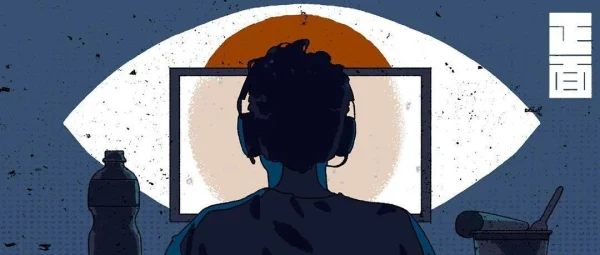
At first, I want to say certain vaporwave artists, but recently I encountered a very weird rabbit hole on the Chinese internet. It started from here.
For me, the most interesting thing about this story of internet trolls and nihilistic online/offline harassment on the Chinese internet is that it has meticulously chronicled its own history (often with live updates on wiki sites), almost too ‘retro’ for this to have taken place recently. So, you don’t have to dig so much to capture a comprehensive portrait of these people.
What content can you consume for hours on end?
Tabby cat.
What content urges you to close an app?
Right-wing accelerationist nonsense.
Keep up with Dino Ge Zhang and the Bureau of Low Theory. Get your tickets for The Hmm TO the Chinese Internet on 25 November, and explore hidden gems and little known corners of the Chinese web with us!