The inner world is at it were more mine than the external. It is so intimate, so secret.
– Novalis1
“Art will not disappear into nothingness; it will disappear into everything.”
– Julio García Espinosa2
There are no more secrets online. There used to be a time—a rare realisation—when dropping a Vine reference mid-conversation would trigger a particular moment in a social interaction. A recognition, an identification of a collective secret that only a few would be lucky to hold. A shared reference passed on by those who got to enjoy the six-second video platform before it completely vanished early 2016, when it was replaced by Musical.ly, TikTok’s predecessor. Nowadays, Vine has been reduced to curated YouTube compilations, most of them becoming an online obituary to the platform with titles like ‘Vine Compilation that gives me my will to live also RIP Vine’ or even describing that serendipitous occurrence ‘Vines i reference every day: RIP VINE’.
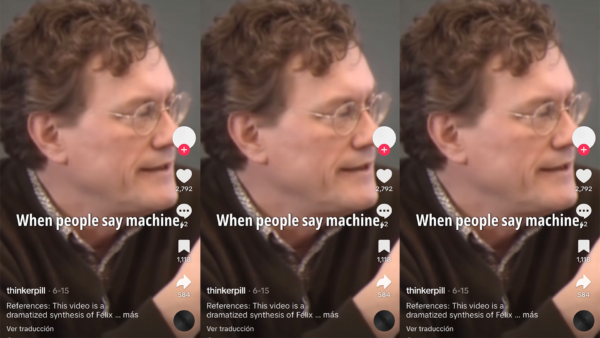
These videos feel almost analog, nostalgic and even quaint in comparison to the current storm of content that is perhaps sometimes too fast to follow. As of today, the online stream of consciousness goes like this: AI slop fruit soap operas uploaded in fragments that have people in the edge of their seats, Clavicular got mogged3 by an ASU frat bro micro-dramas, post-structuralist philosophers like Félix Guattari getting AI’d back into their own texts (I must say, this one got me the first time), a virtual Peter Griffin interpreting Marx and streamers carrying their own Panopticon live. Let’s of course not forget about Tung Tung Tung Sahur and its character development from Italian brainrot member to TikTok dancer. But if Vine felt like a shared secret, this new avalanche of content and meta-references condenses in a recognition without intimacy
The lack of intimacy gets lost in the immediacy of it—you see an AI slop fruit video in your feed and you instantly recognise the format. It is a cognitive act, where one pattern matches a meme grammar. The speed at which this recognition takes place precludes the dwelling of online intimacy. Although this content is precisely designed to be attachable, it misses that someone or collective to attach to. It is humanless, it feels and it is circulated humanless.
Anna Kornbluh impeccably defined this phenomenon in her book ‘Immediacy, or the Style of Too Late Capitalism’(2024) where she writes “Immediacy crushes mediation. It is what it is. Self-identity without representation, ferment with “no words.”4 This characteristic, which she applies to define the current status of art, literature and cinema, just accelerates even more within the digital sphere.
The significance of an image lies not in the image itself, but in its recognition by others. Recognition without circulation, therefore, remains incomplete: there is no sender without a receiver. On the internet, recognition is sustained by circulation. In her essay ‘In Defense of the Poor Image’, Hito Steyerl states that contemporary images gain “another form of value defined by velocity, intensity, and spread”5. Poor images are those that are low-quality and mass circulated, so basically the internet in a nutshell. The value of these images is not in its aesthetic nonconformity, but the fact that other people have experienced it too. These circulations are the social life of the poor image.
References are not longer about the original image itself, but their dispersion and fragmented temporalities. When these references escape the screen, those are the ones I am attracted to the most—reaching spaces they were never meant to be at. A few months ago, I surrendered to the collective hysteria of the Venice Biennale and it was quite a trip. Not because of an impossible itinerary, nor the babies I babysat at the Japanese Pavilion, nor the porta potty I used that was part of a Florence Holtzinger performance. No, this is all typical art shenanigans. The unexpected turn was, once again, Tung Tung Tung Sahur.
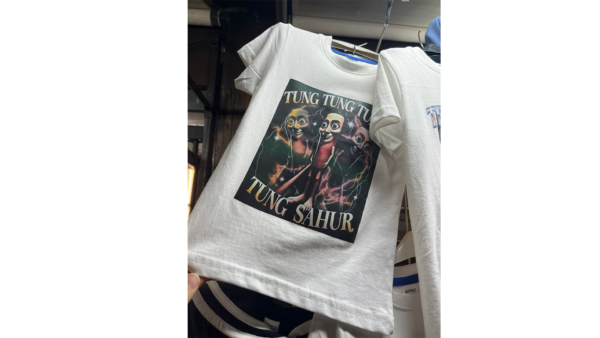
The Italian brainrot character was everywhere: on my feed as I doomscrolled through a delayed flight, other people’ s screens, overhead conversations of strangers, as a joke in between conversations with friends and mostly, on T-shirts sold by street vendors and, surprisingly, at a stunning 15th century neo-gothic palazzo by the Grand Canal. On the first floor, Tung Tung Tung Sahur stood, almost life size, on a vertical screen. It was an exhibition by the artist duo Eva & Franco Mattes by the name of ‘Ragebait’. In a room full of strangers, I was sitting beside other people: art world regulars or, perhaps, potential collectors. The vertical screens showed Tung Tung Tung Sahur having an eerie conversation about real-life problems. We were all there together watching Tung Tung Tung Sahur, but something had inverted.
The deeply online image had managed to revert the dynamic of cultural signifiers. Instead of aesthetics being legitimised and absorbed to the broader public through the white cube, the image had already been produced and circulated way before it reached the white cube. To put it simply: the brainrot became art because it was a brainrot in the first place. The chaos and excess is the main substance that made it work.
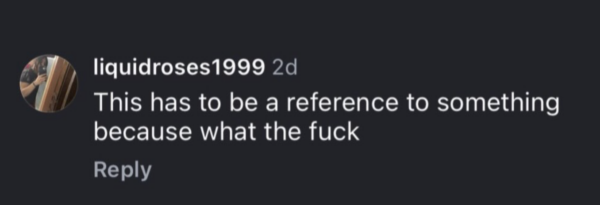
As Walter Benjamin predicted in 1936: “The masses are a matrix from which all customary behaviour toward works of art is today emerging newborn.”6. If film initiated a transformation in collective perception, the internet intensifies it into a participatory condition. Likes, reshares, comment sections, counterfeit products, references in language start to produce a mold that adds to its cultural weight. Like a fossil, shaped by the pressure of everything that surrounds it. But how can you accurately reference the aesthetics, secret languages and political impact of mass circulated images without mimicking the internet itself? Because everyone can look at an artwork with Tung Tung Tung Sahur in it and think to themselves “Ah haha yeah, I get the reference”. Sometimes meaning collapses into shared readability.
Perhaps, the emerging newborn that Benjamin mentions has a second implication: to be an emerging newborn is to be ungoverned? It arrives with no institutions to shape it, growing instead through the cracks, unjustified and unexplained. This is obviously not the case of Tung Tung Tung Sahur then, the AI slop figure is engineered and developed to go viral.
This is, though, the case of internet cinema. This term, first coined by writer Chuck Tryon in 2007 in his essay ‘New Media Studies and the New Internet Cinema’7, refers to a genre of film “as a site for navigating and working through everyday experience, focusing less on an individual film.”8 This process of navigating through the internet has automated and hardened into an attention economy that generates at a too-fast-to-keep-up pace. When mentioning the concept of internet cinema, one could perhaps envision my experience in Venice that I described earlier: seeing something from our feed—brainrot, for instance—on a big screen. But there is a categorical distinction. Tryon goes further to mention how internet cinema “might be used to further cinema’s position as an alternate public sphere” and how it will “reshape concepts such as ‘nation and community”.
An alternate public sphere demands friction through a shared experience, which is maybe, and hopefully, not the decision of an algorithm. Tung Tung Tung Sahur flattened, it didn’t ask anything other than watching. On a screen, the figure can only be watched, not interacted with. But interaction is what gave it meaning in the first place!
My first encounter with Internet Cinema was actually not through reading Chuck Tryon’s essay on my screen but, actually through an IRL experience. A few months ago, I received a DM on Instagram from a friend with a post of event taking place in Amsterdam organised by @_opensecrett_, she was asking me if I would attend. Something of a seemingly secret-society immediately drew me to the screening that would take place at the cultural space OT301 in Amsterdam.
When I arrived, I found myself in a rather peculiar yet familiar setting: a cinema that appeared, at first, entirely normal; red velvet seats, the residual smell of popcorn, couples and friends in quiet conversation… However we were not there to watch a movie. The majority of images that were unfolding in front of my eyes I had seen before, or so I thought, a sort of content déjà vu– only this time it was different. The screen was not vertical and I wasn’t alone in my room. Shared laughs at references and a quiet comfort in a form of sociality that so often feels fragmented. I was bearing witness to the so-called ‘internet cinema’.
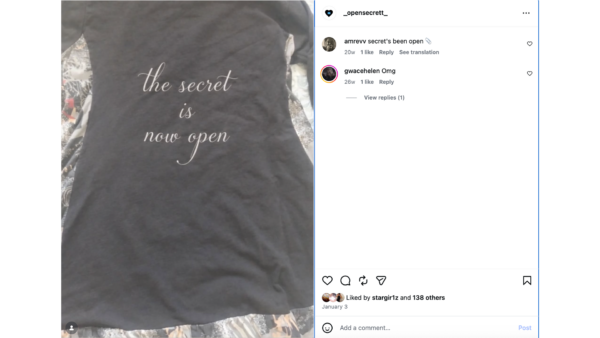
Open Secret was founded by artist Dana Dawud. As she put it in a Spike Art Magazine interview with writer and cultural critic Persis Bekkering, titled ‘The Internet Is Already Cinema’: “I am not interested in showing slop”. Open Secret is a film programme organised autonomously and most times announced in short notice through an Instagram post, which is how I encountered them as well.
In the Spike Art Magazine interview, Dana draws on German philosopher Novalis whose message of seeing the world “by hidden correspondences between people, nature, spirit and language” offers an accurate way to which the artist sees Open Secret. Internet as the landscape, internet as the image, internet as poetry and code. Not as the image itself. Sitting on that velvet chair, I realised this is what the internet really is (or should be) about and for: a portal. Not a door to nostalgia but a language—a hidden correspondence. Films shown on screen by artists Dana Dawud, Redacted Cut, Onty, Xafya Lovecraft, Daniel Stolzlederer, and Mischa Dols suddenly stopped functioning as just ‘online content’ on screen, like it did in that neo-Gothic Palazzo. The images started to embody this collective open secret that dissolves the frontiers between IRL and IVL. The audience becomes part of the secret and the art itself.
Open Secret felt mysterious, weird, unfamiliar, yet also refreshing, because it understands that the internet should not just be a topic of representation, but affective material. No instrumented engineering that offers you what you’ve fed the machine in the first place. Just an announcement post, a date and a location somewhere in the globe—Benjamin’s matrix or ‘today emerging newborn’9. The social media posts of Open Secret offer a line-up, without further information on the screenings. That collective uncertainty shared among everyone who showed up that day felt like remnants of an internet that was and will never be again. An experience you don’t realise how much is needed until you attend an Open Secret event.
Already in 2007 Tryon highlighted how ‘amateur moviemakers’ had “begun to rethink the language of cinema”. Now we can even say that amateur internet movie makers have begun to rethink the language of the internet, by going back to its initial social infrastructure and rejecting frictionless, humanless consumption. This shift is acknowledged by writer Joanna Walsh who, in her book Amateurs!: How We Built Internet Culture and Why it Matters (2025), traces how making art was always the founding base for internet culture. Walsh brings into attention the importance of this craft as even a political statement by saying: “amateurism wasn’t a moment, it is a movement international, intercultural and like all revolutions; imperfect.”10 This imperfection precisely describes the textures of the Open Secret screenings. Screenings are organised throughout the world: Detroit, Valencia, París, Toronto, Mexico City among many other places and no screenings are the same– the curation by Dana Dawud doesn’t travel intact because it is flawlessly crafted for the people who attend.
That evening made me feel human in a strange way. It helped me imagine. The films were about me, you, us and everyone. It was the internet.
A few months later, when I was sitting in that fancy Venetian Palazzo I thought of that moment again. In front of Tung Tung Tung Sahur looping on a vertical screen mounted sideways across a horizontal wall, I was wondering if this was the way he was meant to be consumed after all or not. The room was full but it was completely alienating and smooth, way too smooth. Like a new iPhone screen type of smooth. I had nothing to grab onto except the memory of that random Thursday evening in that velvet chair, the one I had sat in months earlier, in Amsterdam, holding a secret only a few of us were lucky enough to share. Hidden correspondences, held open… An amateurism, secretly, imperfectly and perfectly in a room full of strangers, just how the internet was meant to be.
References
| ↥1 | Novalis. Philosophical Writings. Translated by Margaret Mahony Stoljar. State University of New York Press, 1997. p.130 |
| ↥2 | García Espinosa, Julio. For an Imperfect Cinema (1969) |
| ↥3 | Mogging is an internet slang term used to describe when someone appears significantly more attractive than another person, making the other person seem less attractive in comparison. |
| ↥4 | Kornbluh, Anna. Immediacy, or the Style of Too Late Capitalism. Verso. 2023. |
| ↥5 | Steyerl, Hito. In Defence of the Poor Image. E-flux, 2009. p.7I |
| ↥6, ↥9 | Benjamin, Walter. The work of art in the age of mechanical reproduction. 1936 p.17 |
| ↥7 | In his essay Chuck Tryon uses the term New Internet Cinema. |
| ↥8 | Tryon, Chuck New Media Studies and the New Internet Cinema. vol. 5, no. 1. 2007 |
| ↥10 | Walsh, Joanna, Amateurs!: How We Built Internet Culture and Why it Matters (London: Verso, 2025), p.221. |