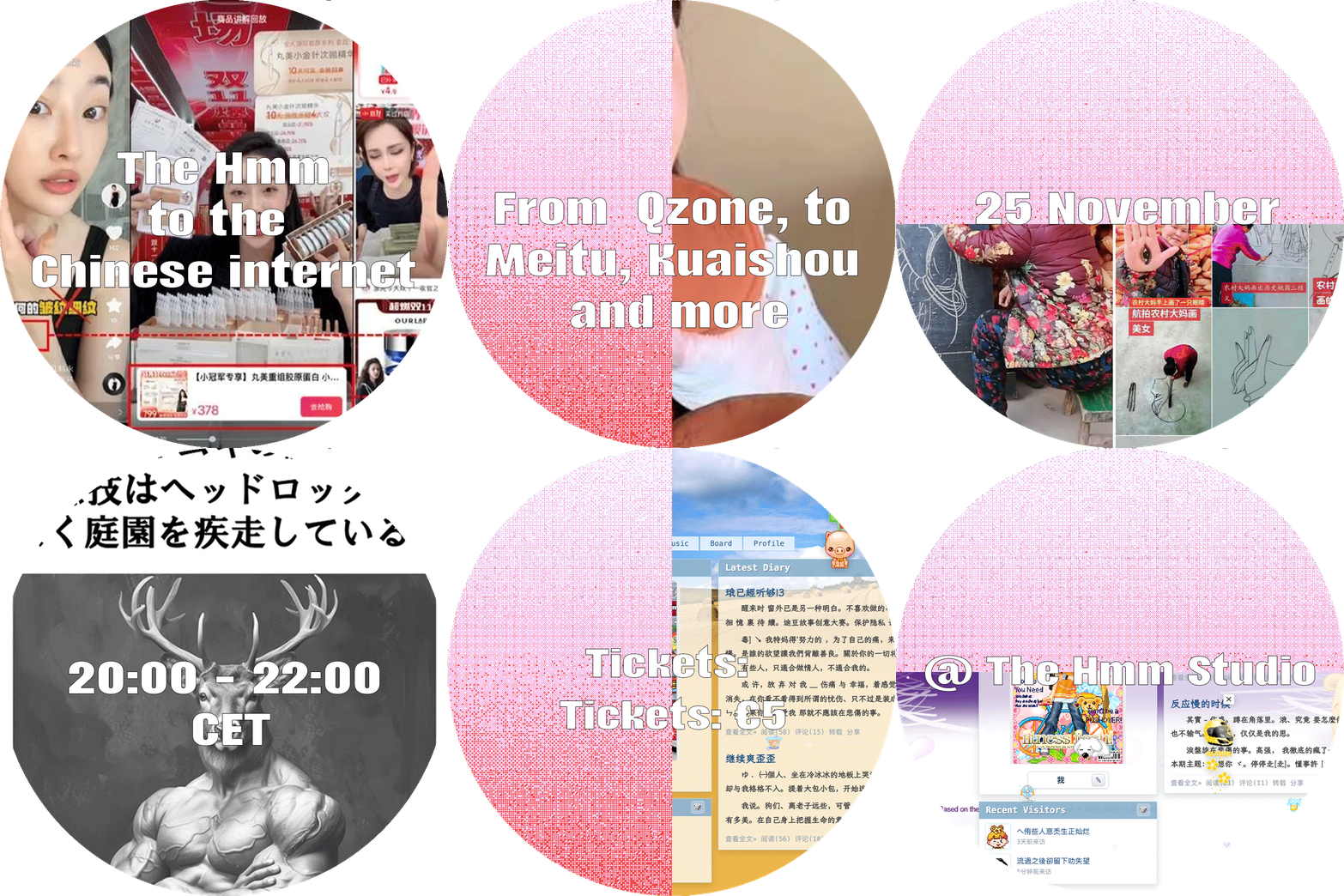
What does the Chinese internet look like from the inside?
The Hmm’s Chinese Internet Tour takes you on a guided trip through China’s social media ecosystem, led by media anthropologist Dino Ge Zhang whose research focuses on emotions and relationships on live streaming platforms in the Chinese-speaking world.
We’ll visit destinations like the face-filter app Meitu (美图公司) and the Myspace-like relic Qzone (QQ空间) to the TikTok-style short-video platform Kuaishou (快手), where artists, researchers, and designers with local expertise show us how these platforms work, what makes them distinct, and how to navigate the practical barriers to using them.
We often think of the social media platforms we use in the West as global. Yet behind China’s Great Firewall, a vast and largely separate social media ecosystem has developed, with platforms that are used by hundreds of millions of people but remain relatively unfamiliar outside the country. These platforms have their own cultures and conventions, shaped by China’s particular internet landscape. They are also spaces where new trends, memes, and visual languages emerge, many of which eventually make their way onto the global internet, sometimes months or years later.
For people outside China, getting a glimpse of these platforms means seeing the internet from a perspective that is rarely available. Many got their first glimpse of this world in January 2025, when RedNote (小红书) surged in popularity after the US government threatened to ban TikTok. For a brief moment, the platform became a possible refuge for TikTok users, attracting a wave of curious newcomers from outside China. But TikTok was only unavailable for about a day, and most of these new users remained RedNote day-trippers.
The Hmm’s Chinese Internet Tour picks up where that moment left off. Moving beyond RedNote, we’ll explore the wider landscape of platforms, communities, aesthetics, and strange digital corners that make up China’s internet, and get a sense of what it looks like from the inside.
What you need to know
Guided by Dino Zhang
📅 Date: Wednesday 25 November 2026 🕗 Times: 20.00 – 21.30 CET 📍 Location: The Inbetween 🎟 Tickets: €5
Funa Ye is an artist and researcher based between Beijing and London. Working across moving image, installation, performance and participatory projects, she explores vernacular aesthetics, internet cultures, beauty technologies and artificial intelligence in contemporary China. She teaches at the Central Academy of Fine Arts and is completing a practice-led PhD at the Slade School of Fine Art, UCL.
Jiaxi Hou
Jiaxi Hou is a Research Fellow at the RMIT University node of ARC Center of Excellence for Automated Decision-Making and Society (ADM+S). As an interdisciplinary ethnographer, their work explores the constitutive relationships between digital innovations and ways of marginalization.
Jiaxi received their PhD from the University of Tokyo in 2024, focusing on the remaking of social class in digital China. Extending this inquiry to the wider Asia Pacific, their current work examines how subaltern groups appropriate emerging technologies—specifically, blockchain and AI—how grassroots economies are thus reshaped by automated systems, and the invisible labor underpinning these dynamics.
viola he
viola heis a Shanghai / NYC-based multimedia artist, educator, electronic musician, and creative technologist. They make web and irl performances and experiences, exploring alternative structures, systems, and interfaces across digital and physical mediums. Viola is an organizing member of Livecode.NYC, an incubator member at NEW INC, and co-runs experimental game collective [[rect*]] repair✧ ദ്ദി(˶•̀ᴗ-˶)
Gabriele de Seta
Gabriele de Seta is, technically, a sociologist. He is a Researcher at the University of Bergen, where he leads the ALGOFOLK project (“Algorithmic folklore: The mutual shaping of vernacular creativity and automation”) funded by a Trond Mohn Foundation Starting Grant (2024-2028). Gabriele holds a PhD from the Hong Kong Polytechnic University and was a Postdoctoral Researcher at the Institute of Ethnology, Academia Sinica and at the University of Bergen, where he was part of the ERC-funded project “Machine Vision in Everyday Life”. His research work, grounded on qualitative and ethnographic methods, focuses on digital media practices, sociotechnical infrastructures and vernacular creativity in the Chinese-speaking world. He is also interested in experimental, creative and collaborative approaches to knowledge-production.