In recent years, concerns over social media’s impact on cognitive abilities has been growing. While it’s very hard to prove a direct causal link with online platforms, studies have show that since the early-to-mid-2010s, literacy and abilities like reasoning and problem solving have been declining.
In tandem with this measured decline in literacy we see the theory that social media, or short-form video content, is ushering in a new age of orality gaining popularity. During the first oral era, before the invention of the written word and widespread literacy, the main way of sharing information was verbally. The switch to a literate culture is thought to not only have changed our relation with information, but even to have reshaped our consciousness. Now, with contemporary social media, some theorists speculate that we’re in a second oral age, where the characteristics of verbal communication are returning as the primary mode of transferring information within our network of online platforms.
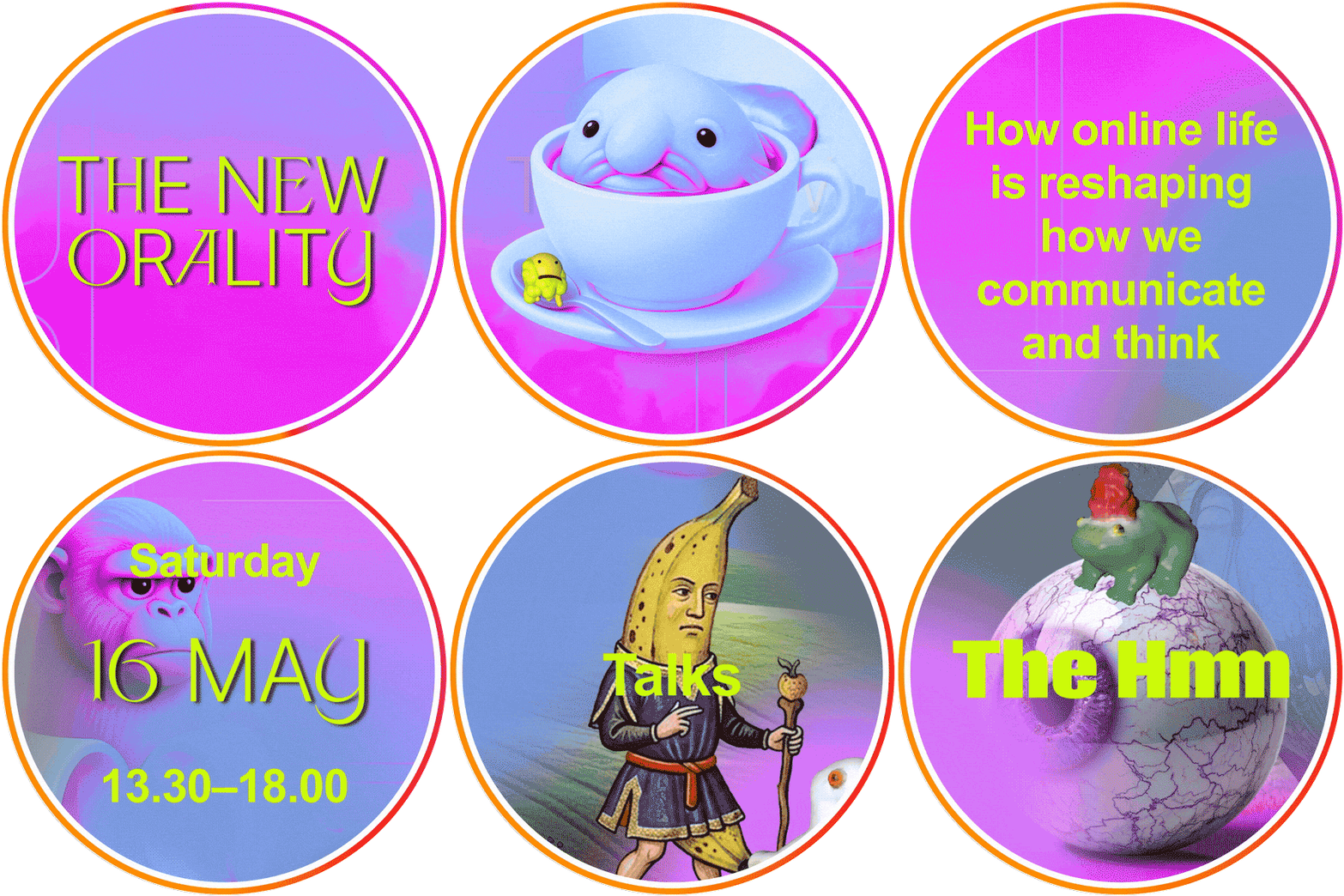
With the Symposihmm: The New Orality we want to explore this pivotal moment. Are online platforms chipping away at our ability to read and understand? Are we entering a new oral age, and what are the implications of this? Are there fruitful ways to push back against this shift, or should we be searching for more meaningful ways to make sense of these new modalities so we can navigate our way through them?
📋 Program
13.30–14.45
Welcome and introduction
Talk by Elise Swart on literacy and online platforms
“Video Exchange Trading Spawner Dopamine Hitting Point” by Max
“Doom Scroll Rehab: Cache Cleanse” by Gjorgji Despodov
16.30–18.00
Talk by Reginold Royston on podcasting, new orality and the African mediascape
A panel discussion on how various disciplines (try to) get a grip on the new orality, featuring:
Filmmakers Aylin Kuryel & Fırat Yücel
Researchers Daniël de Zeeuw and Sal Hagen
Author Maxime Garcia Diaz
Performance by Jonas Lund throughout the day
Please note that the video sharing activity, workshops and performance won’t be broadcast on our livestream. Upon arrival at Tolhuistuin you can sign up for one of the activities on a first-come-first-served basis.
♿ Accessibility notes
The IJzaal at Tolhuistuin is wheelchair accessible and there’s an accessible restroom available as well. Find more info on their website.
During the event we can provide live closed captioning for those with hearing impairments and disabilities. Please reach out to us via info@thehmm.nl, at least 3 days before the event if possible, if you are joining on-site and have this access need, so that we can reserve a seat for you within view of the screen with captions. If you are joining online via our livestream, live captioning will be available as one of the streaming modes.
Kevin Munger is Assistant Professor and holds the Chair of Computational Social Science in the Department of Political and Social Sciences at the European University Institute, in Florence. He studies the communication of political information on the internet, and how to make digital social science make sense. At the Symposihmm, he will speak on what we can understand as the new orality. Link
Elise Swart
Elise Swart is Assistant Professor of Education and Learning at the Institute of Education and Child Studies at Leiden University. Her research focuses on neurobiological and cognitive factors, such as attention, that influence reading comprehension. Additionally, her research focuses on effects of the use of technology and feedback on reading. In her talk she will explore the decline in reading proficiency among young people in relation to the rise of digital media and online platforms. And examine how constant distraction and rapid information flows affect concentration, deep reading, and text comprehension. Link
Jonas Lund
Jonas Lund creates paintings, sculpture, photography, websites and performances that critically reflect on contemporary networked systems and power structures. His performative meditation OPTIMAL BRAIN ROT STRATEGY GUIDE: A GUIDED PRACTICE is delivered one-on-one via FaceTime on a phone mounted on the wall. This interactive piece invites visitors into a satirical wellness session that mirrors and critiques our digital behaviours. Link
Reginold Royston
Dr. Reginold Royston is Associate Professor in the Department of African Cultural Studies, and in the College of Computing and Artificial Intelligence at the University of Wisconsin, Madison. He examines technoculture in Africa and the role of diasporas in digital media. His work explores the ‘new orality’ in viral dance, podcasting and other aural media in Black culture. A concept he uses to describe digital media content and its interfaces such as the phone and chatbots where the oral interface will soon dominate our use culture. Link
Maxime Garcia Diaz
Maxime Garcia Diaz is a writer of poetry and prose. She completed an MA in cultural analysis at the University of Amsterdam and an MFA in creative writing at the Iowa Writers’ Workshop. Her debut poetry collection, Het is warm in de hivemind, was awarded the C. Buddingh’-prijs 2022. Her second collection, The network must be built, published in 2025 in both English and Dutch, was nominated for the Herman de Coninckprijs and longlisted for the Grote Poëzieprijs. Maxime is joining the panel to talk about the translating the non-linear, fragmented experience of the internet to text, and more. Link
Sal Hagen
Sal Hagen is a lecturer and postdoctoral researcher in public AI and digital methods at the University of Amsterdam. He currently studies the materiality of AI technologies and how they interweave with cultural and political phenomena. To this end he experiments with novel quali-quantitative methodologies and develops research tools. His PhD concerned the collectivity of radical online subcultures. Together with Daniël de Zeeuw Sal will join our panel talk to discuss digital rhythmanalysis, digital methods, vibes and vectors. Link
Daniël de Zeeuw
Daniël de Zeeuw is Assistant Professor in digital media culture at the University of Amsterdam. He has published in leading media and cultural studies journals on the interfaces between chronically online subcultures, platform logics, conspiracy theories, and political radicalisation. He is also a member of the Open Intelligence Lab and Digital Methods Initiative, as well as co-editor of Krisis: Journal for Contemporary Philosophy. At the Symposihmm, he’ll give a talk about his research on psyop realism. Link
Fırat Yücel & Aylin Kuryel
Fırat Yücel is a documentary director and editor. His work centers around collective filmmaking and resistance against censorship, using the forms and strategies of video essay, archival/found footage, and desktop-documentary. Aylin Kuryel is an Assistant Professor in Literary and Cultural Analysis at the University of Amsterdam researching nationalism, image politics, aesthetics/resistance, and the politics of emotions. She is also working as a documentary filmmaker. Fırat and Aylin will join the panel talk to discuss their film “happiness”, collective filmmaking, video essays and détournement. Link
Maria Mombers
Maria Mombers is a multidisciplinary designer and researcher based in Rotterdam, currently exploring the monetisation of attention and dopamine driven e-commerce. She will host the workshop “Make Your Own Slobject”, on contemporary online shopping. Participants step into the shoes of an algorithm and design and produce a gamified object based on a collected data set. In a playful way, we explore how gamification, manipulative design techniques, and data shape contemporary consumer behaviour. Link
Gjorgji Despodov
Gjorgji Despodov is a multidisciplinary artist from North Macedonia, currently based in The Hague, Netherlands. His practice blends investigative methods with playful elements, rooted in storytelling deeply engaging with internet and digital culture. His work often employs familiar objects that reflect personal experiences while opening portals into speculative, world-building narratives. At the Symposihmm Gjorgji will guide you through the ritual of a Cache Cleanse. Link
Max
All of Max’s artistic and life achievements can be traced back to one defining factor: over twenty years of unrestricted, unfiltered, and almost unlimited access to the internet. During the Symposihmm, he will host Video Exchange Trading Spawner Dopamine Hitting Point, for all interested in the communal act of discovering what’s there to unveil in the depths of YouTube. Link