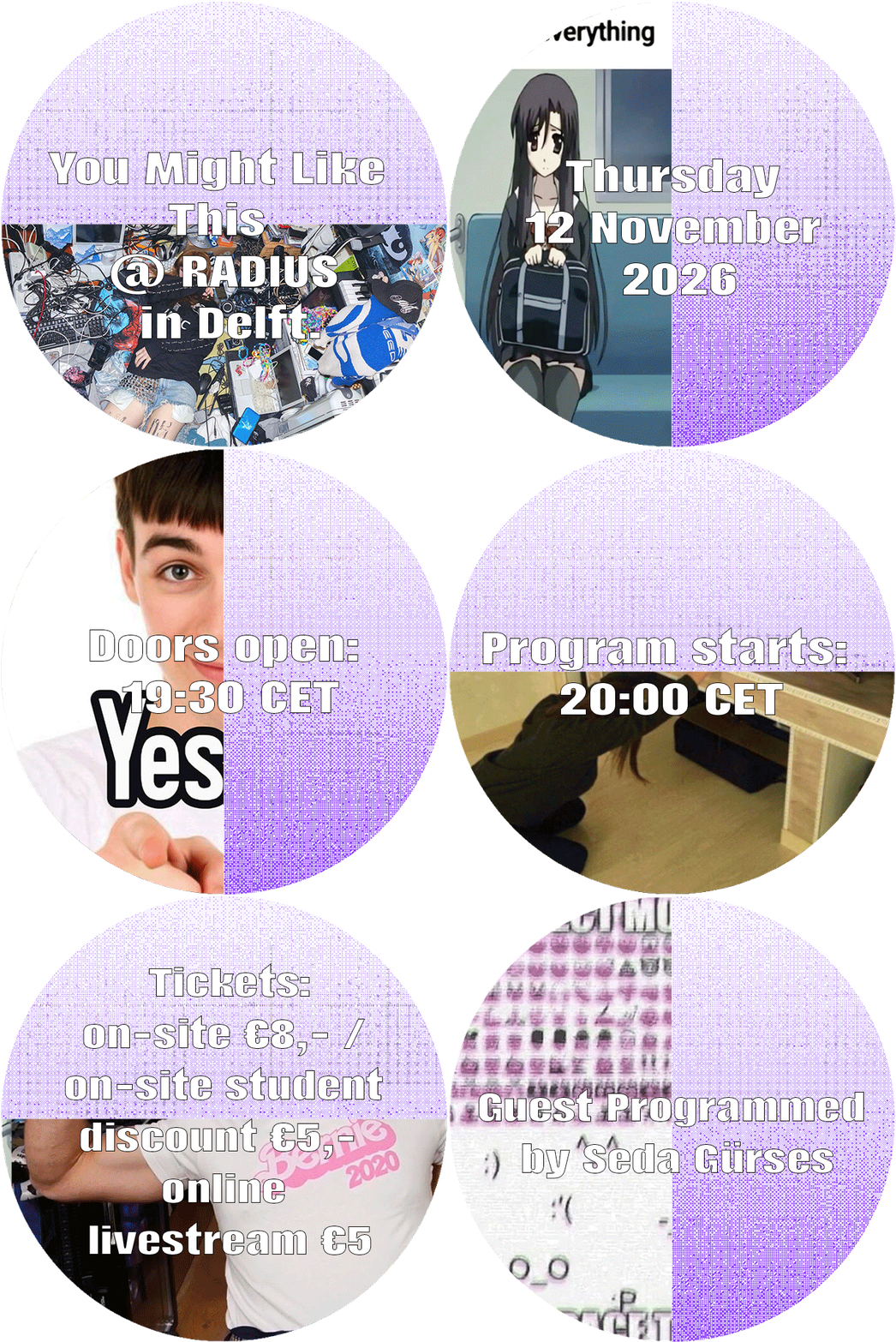
Join us for You Might Like This @ RADIUS in Delft, where six artists, researchers, and makers will share their explorations of and encounters with social media and algorithmic systems. We’re celebrating our 10th anniversary this fall by reflecting on the algorithmic feed, which is turning 10 as well. This event explores how how algorithms shape our online environments.
For this event, we’re setting up shop in Delft, a city we haven’t visited before, but one with a strong connection to algorithmic systems thanks to Delft University of Technology. We’re very excited to have Seda Gürses as our guest programmer. Seda is Associate Professor in the Department of Multi-Actor Systems at TU Delft. Her research focuses on privacy engineering, protective optimisation technologies, software engineering and the political economy of computational infrastructures. She is examining how technical systems intersect with social justice and governance.
Stay posted further down on this page for more information on speakers and the programme.
Due to the historic nature of the building the Water Tower is unfortunately not wheelchair-accessible. During the event we can provide live closed captioning for those with hearing impairments and disabilities. Please reach out to us via info@thehmm.nl, at least 3 days before the event if possible, if you are joining on-site and have this access need, so that we can reserve a seat for you within view of the screen with captions. If you are joining online via our livestream, live captioning will be available as one of the streaming modes.
Ellen van den Assem is a French-Dutch lecturer and researcher. She teaches Media Theory and Philosophy at the Royal Academy of Arts in the Hague. With an MA in Philosophy from Leiden University and a background in design, she develops courses on philosophy of technology, artistic subjectivity, and conditional design, encouraging critical thinking, intellectual curiosity, and the clear articulation of complex ideas. In an academic setting that is all-too concerned about the non-human perspective, she hopes to shift the conversation back to subjectivity, our necessary starting point to relate to and care about the world, others and ourselves – the starting point of any creative process.
For our event, Ellen will give a talk on McLuhan’s Narcissus, exploring what the myth can tell us about attention deficit in the algorithmic age.
Klaudia Orczykowska
Klaudia Orczykowska (@orczi96) is an artist, designer, and writer. A recovered e-girl and Pinterest poet, she looks at how the internet’s narratives shape the way we feel, and how femininity and identity are performed in the immediacy of being online. Using the self as a method, she works across visual forms, sound, fiction and non-fiction writing, with a soft spot for text-based memes, SoundCloud rabbit holes, and pop culture.
At our event, Klaudia will speak about her love for the simple art of Instagram’s “Create Mode” memes. Consisting of little more than a gradient rectangle, some text, and a song, Klaudia sees these templates as powerful philosophical devices for making sense of ourselves and the world around us.
Maja Mikulska
Maja Mikulska is an artist born in Warsaw, Poland, in 2000. She graduated from a BA in Interactive/Media/Design at the Royal Academy of Art, The Hague, in 2026 and interned at The Hmm in 2025. Her work takes inspiration from hours of doom scrolling on TikTok, Instagram and Reddit.
For You Might Like This, Maja will speak about couples’ prank channels on YouTube and the art of selling intimacy without giving it away.
Sander van der Kraan
Sander van der Kraan is a Dutch organizer and communications strategist. Through his work in political campaigning, content creation and commentary, he explores how digital platforms can be used to mobilize people, build movements and drive social change. His work focuses particularly on reaching, engaging and organizing young people in the digital age.
Sander will talk about how the platforms built to capture our attention and serve commercial interests can also be used for political mobilization and collective action. He will explore the contradictions of digital capitalism and ask who really holds the power to shape the future of these platforms